


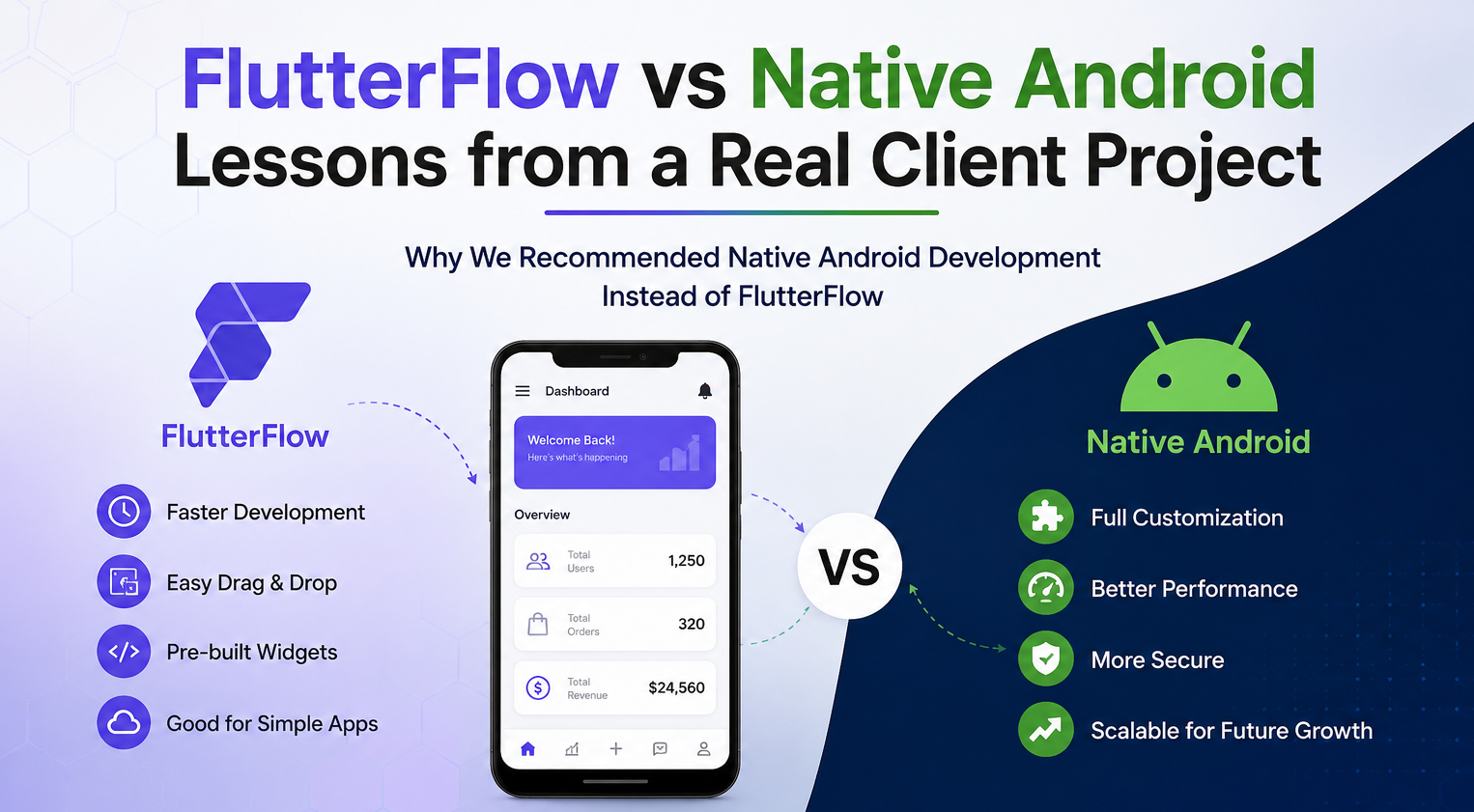
Why We Recommended Native Android Development Instead of FlutterFlow: A Lesson from a Real Client Project
Published by Lofty Soft (Pvt.) Ltd.
Every software project begins with excitement. A client has an idea, developers prepare to build it, and everyone looks forward to creating something valuable.
However, not every project follows the original plan.
One of our most memorable mobile application projects taught us an important lesson about selecting the right technology—not simply the most popular one.
The Client’s Initial Requirement
A client approached us with an idea for a mobile application.
The app initially appeared to be straightforward, so we discussed different development approaches. During the conversation, FlutterFlow was suggested because it offers rapid development for many types of mobile applications.
For businesses with relatively simple requirements, low-code platforms can be a great choice.
But software projects rarely stay simple.
Requirements Began to Change
As development discussions continued, the project scope expanded.
New features were requested, existing screens were redesigned, and business logic became more complex.
The application gradually evolved from a basic mobile app into a system requiring greater flexibility and customization.
At this stage, we realized that continuing with FlutterFlow could introduce limitations as the project continued to grow.
Choosing the Right Technology Matters
One of the biggest lessons we learned was that technology should be selected based on long-term business goals rather than just development speed.
While FlutterFlow can significantly reduce development time for many applications, highly customized business logic often requires more control than low-code platforms can comfortably provide.
Native Android development offers developers complete flexibility to implement advanced features, optimize performance, and integrate complex functionality without being limited by a visual builder.
Honest Communication Is Better Than Short-Term Success
Rather than continuing with a solution that might not meet the client’s future expectations, we discussed the situation openly.
Although this meant the project did not move forward as originally planned, it reinforced one of our core principles:
Our responsibility is not simply to build software—it is to recommend the technology that best serves the client’s long-term interests.
Sometimes that recommendation means saying,
“This technology may not be the best fit for your project.”
Every Project Is a Learning Experience
Not every project ends with deployment.
Some projects provide something equally valuable—experience.
This project strengthened our understanding of requirement analysis, technology selection, and the importance of planning for future scalability before development begins.
Today, we spend more time discussing future requirements with clients before recommending any development platform.
Our Advice to Businesses
Before choosing a development framework, ask yourself:
- Will my application grow over the next few years?
- Will I require custom workflows?
- Will I need third-party integrations?
- Will I add advanced features later?
- Can my chosen technology adapt to future requirements?
The answers to these questions can save significant time, money, and frustration later.
Final Thoughts
Technology should solve business problems—not create new ones.
Every project teaches us something valuable, and this experience reminded us that choosing the right development approach is just as important as writing quality code.
At Lofty Soft (Pvt.) Ltd., we believe in honest technical guidance, even when it means recommending a different path than the client initially expected.
Our goal is to help businesses invest in solutions that remain reliable, scalable, and valuable for years to come.